Eliminating Elective Deliveries Under 39 Weeks Gestation

The goal of this initiative is to eliminate elective deliveries under 39 weeks’ gestation without documented pulmonary maturity studies in participating hospitals

June 2011 - Teams continue to work with PQCNC to track scheduled deliveries <39 weeks

Teams are continuing to record and use data to plan and implement changes to eliminate elective deliveries under 39 weeks gestation without documented pulmonary maturity studies...

March 2011 - Teams continue to work with PQCNC to track scheduled deliveries <39 weeks

Teams are continuing to record and use data to plan and implement changes to eliminate elective deliveries under 39 weeks gestation without documented pulmonary maturity studies...

December 2010 - Teams continue to work with PQCNC to track scheduled deliveries <39 weeks

Teams are continuing to record and use data to plan and implement changes to eliminate elective deliveries under 39 weeks gestation without documented pulmonary maturity studies...

RISK: Consequences of a Near Term Birth

Written and Directed by Erik Ewers, Your Story Films, Walpole, NH. Produced by Julie Coffman, NNEPQIN producer Becky Ewing, MD. Co Stars: Michele Lauria, MD, Bill Edwards MD, Andrea Damato and Bonnie Morrissette

Risk is a very human twenty minute educational DVD that helps patients and their providers experience potential outcomes of elective late preterm delivery through the stories of two moms.

Dr. Lauria and Dr. Edwards provide the medical context in language that is accurate and understandable.

More here


PQCNC in the Durham News!

Short-changing babies - Read the full article

"Thank you, PQCNC, for bringing the problem of elective late-preterm births to our attention and for giving our doctors the support they need to truly talk to their patients and each other."

September Update - 39 Weeks Initiative wraps up successfully!

teams


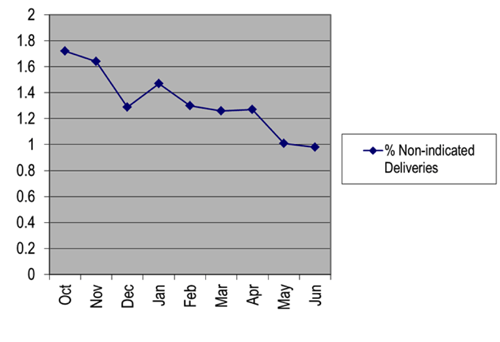
On August 31, 20 teams came together in Chapel Hill to celebrate the accomplishments of the 37 hospital teams that worked to achieve a 43% decrease in the rate of elective deliveries <39 weeks between October 2009 and June 2010.  Hospitals shared strategies they have implemented over the past year to reach their goals of reducing elective deliveries <39 weeks.  Teams reported that they have noticed less congestion in their L&D units as a result of fewer admissions for elective inductions. Hospitals have noted a decrease in NICU admissions and newborn complications. Several hospitals discussed the importance of having a peer review mechanism in place to address deliveries performed before 39 weeks without clear medical indication. The data collected for this initiative also showed an increase in the presence of evidence in the chart to support medical indications for non-elective early deliveries, and an approximate 12% decrease in scheduled deliveries (both inductions and c-sections) at gestational ages between 36.0 and 38.6 weeks.
 
Through our partnership with March of Dimes for this initiative, a press release was issued in conjunction with the final learning session, and the 39 Weeks Project received coverage from the Raleigh News & Observer and WUNC, the local National Public Radio affiliate.
 
In addtion to reviewing data, the learning session included a web-based presentation by Kathleen Rice Simpson, RN, PhD, FAAN on safety and best practices in labor induction.  Two panel presentations focused on the role of physician leadership in achieving quality improvement in maternity centers and the importance of transparent communication between patients and providers to ensure decisions about scheduled delivery remain focused on what is safest for mother and baby.  Two patients shared stories about physicians who built trust with them by sharing information and taking time to talk with them about making decisions about their pregnancies.  These stories highlight the best practices which already exist in North Carolina and which PQCNC can disseminate through collaborative learning sessions such as our meeting on August 31.
 
We also took time to recognize the hospital teams who worked so hard to collect data on all inductions and scheduled c-sections between 36.0 and 38.6 weeks of gestation over a nine month period and who continue to strive to deliver high quality maternity care.  On a lighter note, PQCNC bestowed various awards of recognition, including the Most Data Entered between the Hours of 1:00 and 4:00am, the Dog Ate My Homework Award (for best excuses for missing data entry deadlines), and the Healthiest Wrists Award (to the hospital that so few scheduled deliveries <39 weeks they entered almost no data).


melissastrausstawana

August 2010 - PQCNC is pleased to have been able to partner with the March of Dimes

PQCNC is pleased to have been able to partner with the March of Dimes and we're grateful for their support in our work in reducing elective deliveries less than 39 weeks. 

This initiative was of particular interest to them as both the March of Dimes and the American College of Obstetricians and Gynecologists have been urging all pregnant women and their health care providers to go to 39 weeks of pregnancy whenever possible unless there is a medical necessity to deliver early - a baby’s brain and lungs are still growing in the last weeks of pregnancy. Babies born just a few weeks too early are more likely to die during their first week of life; and those who survive are more likely to suffer breathing problems, feeding difficulties, temperature instability (hypothermia), jaundice, and delayed brain development. 

A March of Dimes analysis of births between 1992 and 2002 suggests that increasing rates of Cesarean section deliveries and induced labor have contributed to a 12 percent increase in births occurring between 34 and 36 weeks, known as late preterm births.

Working together, we have begun to reverse this trend in North Carolina...

MOD logo

July 2010 - 20 teams will continue to work with PQCNC to track scheduled deliveries <39 weeks

While formal data collection for the 39 Weeks Project wrapped up on June 30, 2010, several teams expressed interest in continuing to collect data either to ensure they hold the gains made over the past year or to measure ongoing improvement as they continue to implement changes to reduce elective deliveries <39 weeks.  PQCNC has created a new data entry program to support the collection of this data through June 2011 and will continue to prepare monthly and quarterly reports for all hospitals entering "continuation data.

June 2010 - 39 Weeks Project final learning session planned for August 31, 2010

What - Final learning session for the PQCNC 39 Weeks Project.  Kathleen Rice Simpson, PhD, RNC, FAAN will speak by webinar about induction safety, panels made up of representatives of North Carolina hospitals will share their work, and teams will have time to learn from each other and to develop long-term plans to prevent elective deliveries <39 weeks.
When - Tuesday August 31, 9:30-3:30
Where - Sheraton Chapel Hill
Who - 2-4 members of your 39 Weeks Project team, including your nurse champion, physician champion and hospital administration representative

All 39 Weeks Project participating teams are encouraged to attend at no cost; CME Category I credits (applicable for MDs, CNMs, NPs and RNs) will be provided free of charge.

Register here

May 2010 - Second quarter reports are ready!

Each participating hospital received a detailed report this month based on data they submitted on scheduled deliveries <39 weeks from January to March 2010.  Six months into the 39 Weeks Project, the data reflects an ongoing decline in elective deliveries <39 weeks, with a more marked decline in repeat low-transverse c-sections (without additional medical indication) compared to the first quarter of this project.  For those deliveries <39 weeks with medical indication, an increasing percentage of those deliveries had objective evidence in the chart supporting the indication for delivery. It also appears that more hospitals are documenting a Bishop Score prior to initiation of an induction of labor, compared to the first quarter.  
 
On the monthly call this month, criteria for establishing gestational age were reviewed.  The "gold standard" for establishing or confirming the EDC is an ultrasound before 20 weeks.  Some hospitals are asking both for gestational age and for the criteria used to determine that gestational age when scheduling an induction or repeat c-section that is not medically indicated.  Concerns were raised about cases in which a gestational age may have been adjusted later in pregnancy.  Many hospitals are now documenting the indication for a planned delivery <39 weeks at the time the delivery is scheduled.  Some hospitals have done outreach to the providers who deliver at their facility so that practices will have all needed information when calling the hospital to schedule an induction or c-section.

April 2010 - 39 Weeks Project All-Team Webinar #2

The second all-team webinar featured maternal-fetal medicine specialists and neonatologists from both North Carolina and Ohio, as leaders of the 39 Weeks initative of the Ohio Perinatal Quality Collaborative (www.opqc.net) joined physician champions from the PQCNC 39 Weeks Project to share their work on these initiatives.  Presentations focused on appropriate management of various clinical complications at or near term, such as IUGR, oligohydramnios and hypertensive disorders, the neonatalogy perspective on complications related to scheduling delivery too early, and concerns about the accuracy of gestational age dating for scheduled delivery <39 weeks.  To access all presentations, as well as an audio file of the webinar, click here.

"Maverick"

On the importance of the "Eliminating Elective Deliveries Under 39 Weeks Gestation" Initiative.


Maverick's video has moved - click here to view

March 2010 - Regional meetings

In mid-March, half of the teams in the collaborative met either in Hickory or Wilson to discuss areas of success and ongoing challenge while sampling local barbecue.  Many teams have made significant progress toward their goals and shared innovative strategies; most teams identifed opportunities for further improvement.  Below are some of the ideas shared by teams at the meetings:

- Several hospitals have utilized an existing peer review process or developed one as part of their work on this project to review cases scheduled <39 weeks without medical indication or where the medical indication is not supported by evidence in the chart.
 
- Labor & Delivery units with dedicated operating rooms have a greater ability to put a "hard stop" on scheduling repeat low transverse c-sections <39 weeks.
 
- At some hospitals where c-sections are done in the main OR, all c-sections must be cleared by L&D before they are posted by the OR scheduler.

- Physicians report that the March of Dimes brochure "Why the last weeks of pregnancy count" has been a helpful tool when counseling patients about the timing of a scheduled delivery.

- Some hospitals include messages about waiting until 39 weeks for planned deliveries in the patient education materials patients receive early in pregnancy or as part of their marketing videos about their maternity services.


Hickory!

Hickory Meeting

western bbq


Wilson!

Wilson meeting

eastern bbq


Next all-team webinar is April 27, 2010 at 0730-0915

We will hear from maternal fetal medicine specialists and neonatologists affiliated with the PQCNC 39 Weeks Project as well as from the Ohio Perinatal Quality Collaborative.  They will address criteria for scheduling delivery <39 weeks for some of the more common indications, such as hypertension and oligohydramnios, the pediatric perspective on increased complications seen in near-term infants, accuracy of gestational ages among scheduled deliveries <39 weeks, and results from the Ohio Collaborative's work since 2008 on reducing elective deliveries <39 weeks.  There will also be a quick update of the 39 Weeks Project data showing trends from October 2009 through the end of March 2010.

Click here to access webinar page.

March 2010 regional meetings for 39 Weeks Project teams

The western regional meeting will be held in Hickory on Tuesday March 16 from 10-1.  The eastern regional meeting will take place in Wilson on Wednesday March 17 from 10-1.  First quarter data will be reviewed, but the majority of the session will be a “town meeting” where teams can exchange ideas and resources.  Please send no more than 3 people from your site; we hope to have as many teams as possible represented and want to keep the group small enough to allow for an interactive session.

February 2010 – First quarter data reports are underway

35 teams submitted data for each month of the first quarter, October, November and December.  Data reports are being prepared for each hospital and aggregate data will be posted on the website in early March.  Preliminary analysis of the data indicates that the number of scheduled c-sections and inductions between 36w0d and 38w6d decreased overall during this time period, which may reflect seasonal variation, and that there has been a decrease in the percentage of cases scheduled without medical indication in the first quarter of this project.

January 2010 – 39 Weeks all-team webinar

The January 26 webinar featured speakers from Massachusetts General Hospital, the PQCNC expert panel, Institute for Healthcare Improvement and AWHONN and was attended by over 100 people, including sites participating in the 39 Weeks Project and colleagues working on perinatal quality improvement both in North Carolina and in other states and at national organizations.  Of special interest was the talk by a patient whose baby ended up with a complicated NICU course following a routine repeat c-section at 38 weeks.  To see the agenda, listen to the audio file of this webinar, and access the presentations, click here.

During the monthly conference call/webinar this month, each team gave a brief update of their work to date on the 39 Weeks Project.  Some teams are continuing to monitor their data and have not tested changes yet, either because their current data suggests their rate of elective delivery <39 weeks is low or because they are examining their data to identify areas for potential change and to engage the physicians and midwives who deliver at these facilities.  Other teams have tested changes to how deliveries are scheduled, such as by asking for specific information at the time the case is posted or by designating specific people on the unit who may schedule inductions or c-sections.

New Guides Released on Elective Induction of Labor

The number of pregnant women who delivered via induced labor more than doubled in the last decade, a trend that has implications not only for the health status of newborns and their mothers, but also for the nation’s health care costs.  To help women and their health care providers understand the potential pros and cons of choosing induced labor, AHRQ has produced two free, evidence-based research summary guides. Thinking About Inducing Your Labor: A Guide for Pregnant Women, clearly explains induced labor – the use of medicine or other methods to get labor started – while offering women reasons why they may or may not want to choose the procedure over waiting for traditional childbirth.  A companion guide for clinician, Elective Induction of Labor: Safety and Risks, includes a summary of the clinical evidence on the safety of elective induction of labor versus waiting, and also offers information about maternal and fetal outcomes with elective induction.  Print copies are available by sending an e-mail to ahrqpubs@ahrq.hhs.gov.

December 2009 – PQCNC V

Representatives from about half of the teams in the 39 Weeks Project attended the PQCNC annual meeting in Chapel Hill and had an opportunity to exchange ideas during “town meeting” sessions.   Five teams prepared storyboards, protocols or other examples of their work on 39 weeks to share at the meeting.   For more information about the meeting, click here.   At the monthly webinar/conference call, teams discussed data definitions to ensure consistency across sites and possible approaches to using data to effect changes in practice.

39 weeks poster 1

39 weeks poster 2


December - 39 Weeks on the move

This month PQCNC staff attended the Vermont Oxford Network Annual Meeting and Quality Congress in Washington, DC.  Leaders of statewide perinatal quality collaboratives, including PQCNC, addressed the quality congress.  Both Ohio Perinatal Quality Collaborative and PQCNC spoke about their 39 weeks initiatives, and PQCNC presented three posters, including one on the 39 Weeks Project.

November 2009 – First month’s data is in...

36 of 38 teams who were eligible for October data collection have submitted data.  The two new teams will submit November data.  While PQCNC is available and delighted to meet with hospitals not currently involved in the 39 Weeks Project to support work to eliminate elective delivery before 39 weeks, no additional sites will be added to the existing collaborative.  However, all are encouraged to attend the PQCNC annual meeting in Chapel Hill on December 3.


During this month’s webinar/conference call, the team from Pitt County Memorial Hospital shared changes they have made in their labor and delivery processes, staffing and structure to improve throughput and reduce scheduled deliveries that are not medically indicated before 39 weeks.

October 2009 – The 39 Weeks Project now has 40 teams!

Forty hospitals from across North Carolina, representing about two-thirds of all deliveries in the state, are now participating in this initiative, from large, urban academic medical centers to rural community hospitals with only one or two obstetricians on staff.  There are 2 new teams who are working quickly to complete their retrospective chart review.  See the list of participating hospitals below.  At this month’s webinar/conference call for team contacts, the details of data collection and data entry were reviewed, and sites are now collecting data on all scheduled cases between 36w0d and 38w6d.

PQCNC staff attended the March of Dimes Symposium on Quality Improvement to Prevent Prematurity in Washington, DC this month, where scheduled delivery before 39 weeks was a key topic.  39 Weeks initiatives are underway around the country in statewide quality improvement collaboratives, within large hospital systems, through private health plans, and across communities, such as the Healthy Babies are Worth the Wait project sponsored by the March of Dimes in Kentucky.  

North Carolina March of Dimes continues to be an important partner in PQCNC’s 39 Weeks Project.  The brochure Why the Last Weeks of Pregnancy County are being made available free of charge to all participating sites.  Please contact PQCNC for more information about obtaining these brochures through the March of Dimes.

September 2009 – Action Learning Labs

37 hospitals sent a team consisting of at least a physician champion, a nurse champion, and a senior hospital administrator to a full-day learning session where they worked to develop an action plan specific to their site.  Some teams traveled hundred of miles to participate, a handful of physicians came post-call, and many nurse managers worked creatively to find ways to take a day away from their busy schedules.  PQCNC is very grateful for all of their efforts, as well as those of the people who stayed behind to keep things running smoothly at Labor and Delivery units around the state.

At the learning lab, the group reviewed a summary of the “lookback” data collection they completed in August of charts from 2008, which suggests that approximately half of the scheduled c-sections between 36w0d and 38w6d were repeat low transverse c-sections with no other indication for delivery.  Most inductions had some indication for delivery, although many did not meeting the criteria by the PQCNC expert panel for that indication.  There was great variation among the hospitals, with some having virtually no elective deliveries <39 weeks while at others the majority of scheduled deliveries at this gestational age did not have a medical indication.  

Each team received a report of the retrospective data from their individual hospital, which guided their work on the draft action plan.  Teams will now go back “home” to share the draft action plan with the stakeholders they identified as important contributors to their 39 weeks work.  They will discuss potential changes to test and will prepare to start collecting data on all scheduled deliveries between 36w0d and 38w6d starting on October 1.

39 Weeks Action Learning Labs are next week!

We are looking forward to formally starting our work together as a collaborative.  With 37 hospitals participating, this project has the potential to result in major improvement in outcomes for mothers and babies.

  • Wednesday September 16 at the Hawthorne Inn in Winston Salem
  • Friday September 18 at the Sheraton in Chapel Hill
  • Both days start with registration/continental breakfast at 8:30. The meeting will begin promptly at 9am and end 4:30pm.
  • Lunch and afternoon snack will be provided, and coffee/tea will be available throughout the day.

 
What to bring:

  • Your team, including your physician champion, nurse champion, and hospital administrator.
  • Please dress comfortably and in layers.

 
What to expect:

  • There will be brief lectures, but a significant amount of time will be devoted to your team working together to develop goals and an action plan to eliminate elective deliveries before 39 weeks. 
  • Teams will also have time for open discussion of the results of the "lookback" chart review and of possible strategies and challenges to expect when testing changes related to scheduled deliveries.

"39 weeks" has launched!

35 hospitals have joined the collaborative and are busy completing their "lookback" data collection during the month of August.  Each hospital will abstract data from 25 scheduled c-sections and 25 inductions done at gestational ages between 36-38 weeks.  Reports based on this data will be prepared for each hospital in time for the September learning sessions, and all hospitals in the collaborative will be able to look at all of the data from across the state, blinded to the names of the individual hospitals.   The August 3 webinar reviewed data collection methods and the definition for each variable being studied, to ensure uniformity of the data across hospitals.

The 35 teams participating in the collaborative represent a diversity of hospitals, from small rural hospitals to large academic medical centers, and from hospitals that have been working independently to eliminate elective deliveries before 39 weeks for years to those that are just beginning to look at this issue.  Team members include nurse managers, chiefs of OB departments, community obstetricians, maternal-fetal medicine specialists, staff nurses, nurse educators, performance improvement managers, chief nursing officers, chief operating officers, risk managers, and patient care coordinators.

Upcoming Important dates for the "39 weeks" initiative

Webinar:
Monday August 3, 3-5pm

At this webinar, we will review how to complete the retrospective data collection.  Each hospital will abstract data from 50 charts using a tool developed by PQCNC and enter the data using a web-based data entry program.  Information about how to access the webinar will be distributed to teams who register in an email.  The only person required to participate in this session is the person who will be responsible for chart abstraction/data entry, but all team members are welcome.

Action Learning Lab:
Wednesday September 16, 9-4:30 at The Hawthorne Inn in Winston Salem, NC.
Friday September 18, 9-4:30 at the Sheraton in Chapel Hill, NC.

This one-day session will be held twice.  Each hospital should attend one  session; please select whichever session is more convenient.  All members of the team need to be present for this session.  At the learning lab, the evidence base for the elimination of elective deliveries before 39 weeks will be reviewed, information about quality improvement science will be presented, and the process for ongoing data collection will be reviewed.  There will be time set aside for teams to work individually to develop an action plan for each hospital.  Presenters will include staff from hospitals who have done quality improvement projects on this topic and a patient panel to offer the patient perspective on the value of this work.

Register now for 39 weeks project!

Hospitals interested in participating in PQCNC's collaborative to eliminate elective deliveries before 39 weeks' gestation should register by July 17.  Hospitals of all sizes from across the state have expressed interest and have shared their experiences in addressing this issue on their own, and we are looking forward to joining forces to focus on this issue as a state.  Several hospitals have already completed registration.

Information needed to register:
•    names, titles and email addresses of all team members
•    identification of a primary contact person for the team
•    which learning session your team will attend (Sept. 16 in Winston Salem or Sept. 18 in Chapel Hill)
 
Once your team is registered, you will receive an email with further instructions about how to prepare for the collaborative.  If you are planning to participate but will not be able to register your team by July 17, please let us know, using the "contact us" tab at the top of the page.  We will accommodate all teams who register by the end of July.

Click here to go to the registration form.

June 2009 Expert Team Meeting

The expert team met to review and finalize the data collection forms.  Several decisions were made:  

  • The list of indications on the data collection sheet will include all possible indications which the person reviewing the chart might encounter, including those that may not be legitimate medical indications for delivery before 39 weeks in the eyes of the expert panel.  The report prepared by PQCNC for each hospital will include the frequency of various indications, and each hospital's team can determine whether these are appropriate at a given gestational age.
  • A second column will be added to the list of indications asking whether the chart reviewer was able to find "objective evidence" in the chart (such as lab values, blood pressure or ultrasound report depending on the condition) to support the indication for delivery given by the clinician.
  • For the retrospective chart review, hospitals will review 25 sequential scheduled cesareans and 25 inductions from 2008, at gestational ages of 36-386/7 weeks.  This will provide a baseline of how many planned deliveries before 39 weeks were elective, while eliminating those done at earlier gestational ages, which are generally done exclusively for medical complications.

April 2009 Expert Team Meeting

The expert group guiding this project, including obstetricians, nurse managers and a clinical nurse specialist, all from hospitals who have worked to eliminate elective deliveries before 39 weeks, met by phone to develop a plan for data collection and outcome measurement for this project.  The working definition of "elective" delivery is a delivery done in the absence of a medical indication where delivery would offer a benefit to the mother or fetus/neonate.  This definition will be elaborated by combining working definitions from expert committee member hospitals and other sources, including IHI bundle definitions. Hospitals will be asked to review inductions and scheduled cesarean sections to identify the rate of non-medically indicated delivery before 39 weeks.  Data will be submitted monthly to PQCNC and will include both maternal and neonatal outcomes.   Items to be measured include length of stay on L&D and NICU admission.  The project goal was defined as such: participating hospitals will reduce the number of elective deliveries (induction and cesarean, including repeat cesarean) prior to 39 weeks gestation without a mature of amniocentesis to 90% of baseline or will totally eliminate these deliveries altogether.

Background

Elective induction prior to 39 weeks has been shown to increase the length of labor, complications of labor and cesarean section and operative delivery rates compared to women in spontaneous labor. Substantial data exist showing that infants born by scheduled cesarean section have higher rates of respiratory problems and other complications. In addition, elective deliveries (either by CS or induction) between 37 0/7 and 38 6/7 weeks have been shown to increase neonatal admissions to special care nurseries. Lastly, induction of labor is typically less efficient than spontaneous labor, tying up labor and delivery schedules.